Call for papers
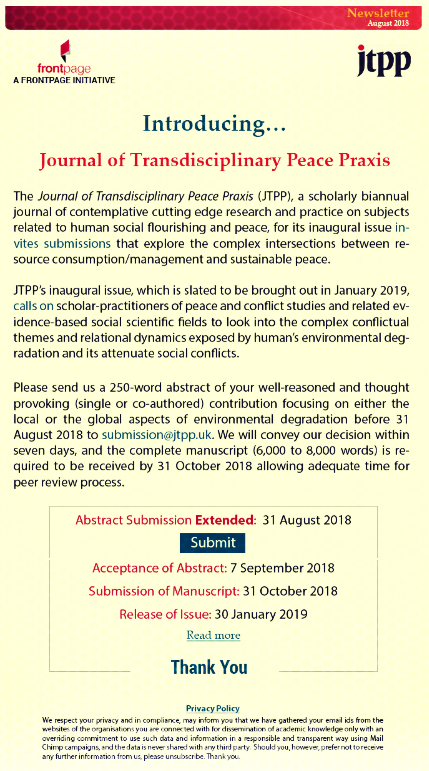
The Journal of Transdisciplinary Peace Praxis (JTPP), a new scholarly journal of contemplative cutting edge research and practice on subjects related to human social flourishing and peace, invites submissions that explore the complex intersections between resource consumption/management and sustainable peace. Well-reasoned and thought provoking single and co-authored works are welcome to focus on either the local or the global aspects of environmental degradation and its attenuate social conflicts.
The realisation of nonviolent peaceful futures calls for collaborative exploration of the complex social and cultural resources, identities and power dynamics of groups in conflict. Environmental degradation and exploitation of natural resources impact all corners of our globe. The narratives of various stakeholders in such environmental conflicts both intersect and diverge as the complexities of human knowledge, interpretation and experience are taken into account. In reality, no single field or discipline is capable of understanding these phenomenon and interrelationships alone. To understand the human ecology of such conflict and change, JTPP aims to create both interdisciplinary and transdisciplinary spaces to discuss and analyse the diverse realities of environmental degradation as a protracted and long-term global issue.
In this inaugural issue, which is slated to be brought out in January 2019, we call on scholar-practitioners of peace and conflict studies, anthropology, public policy, and evidence-based social science more generally, to explore the complex conflictual themes and relational dynamics exposed by human’s ongoing late capitalist environmental degradation.
Specific attention to the following broad questions is of particular interest to the editorial team of the JTPP:
- What values underpin environmental degradation and why might an analysis of these values be important to managing climate change, understanding approaches to resource management, or achieving environmental justice for those most affected by environmental degradation?
- What are the unknown, or under-addressed, cases of environmental degradation and resource depletion?
- How could mapping specific environmental conflicts be of assistance to environmental activists and scholars?
- How does the social and cultural landscape of a place relate to the environmental problems it faces?
- What social and cultural recourses may be able to be tapped to in order to positively transform existing environmental conflict?
- How much of our response to environmental depletion has been driven by an anthropocentric view of the world? How do anthropomorphism and anthropocentrism impact our ability to transform environmental conflicts?
From land and water rights to ecosystem change, local and global environments are facing continuous change and drastic shifts brought on by human consumption, population growth and finite resources, are among many other factors. Understanding, managing and engaging such challenges are central to future peaceful coexistence, and possibly human survival. How does one manage such complex processes in a way that ensures human continuity, equality and justice? Is it possible to balance the preservation of ecosystems without changes to modern demand and consumption-based values? Whose responsibility is it to preserve and sustain the natural environment? While these may not be new questions, these are ones that we believe represent a crucial starting point for the transdisciplinary aims and mission of the JTPP.
While issues of natural resource management and global climate change are often narrated to be intractable or incommensurable, this issue of the JTPP aims to explore creative policies, practices and theories that aim to address the wicked problems [Rittel, Horst W. J. & Melvin M. Webber, ‘Dilemmas in a General Theory of Planning’, Policy Sciences 4, No. 2 (June 1973), pp.155-169] of modern environmental management and change.
We are particularly interested in submissions from practitioners working on the frontlines of environmental degradation and systems change that are realising that transdisciplinary approaches are lacking and desperately needed. In what way is the potential of systemic collapse [Kuecker, Glen & Hall, Thomas, ‘Resilience and Community in the Age of World-System Collapse’, Nature and Culture 6, No. 1 (2011), pp.18-40] and unfettered consumption either driving or hampering peaceful change solutions in local and global conflict contexts?
While this call presents a challenging frame and asks many difficult questions, the hope in this initial issue of the JTPP is to critically examine the collaborative research and practice possibilities inherent in complex change processes. If we can collaboratively develop theories of change that respond to some of the most contingent and pressing conflicts, such as environmental degradation and depletion, then the potential exists to rethink shared response to other wicked problems. JTPP aspires to create this dialogue about the possibilities of broad-based change.
You are encouraged to send us a 250-word abstract of your proposed contribution before 31 August 2018. We will convey our decision within seven days, and the complete manuscript (6,000 to 8,000 words) is required to be received latest by 31 October 2018, allowing adequate time for peer review process. Kindly see the Submission Guidelines in AUTHORS’ CORNER of this website.
In solidarity
Jeremy Rinker, Ph. D.
Assistant Professor & Director of Undergraduate Studies Department of Peace and Conflict Studies
The University of North Carolina at Greensboro, USA
E: jr@jtpp.uk | jarinker@uncg.edu | https://jtpp.uk/