Andrés Arias
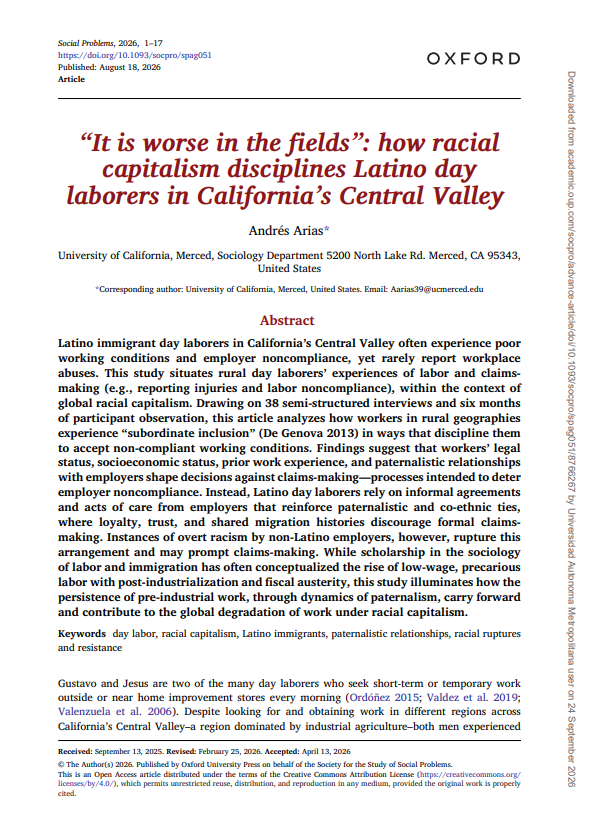
Latino immigrant day laborers in California’s Central Valley often experience poor working conditions and employer noncompliance, yet rarely report workplace abuses. This study situates rural day laborers’ experiences of labor and claims-making (e.g., reporting injuries and labor noncompliance), within the context of global racial capitalism. Drawing on 38 semi-structured interviews and six months of participant observation, this article analyzes how workers in rural geographies experience “subordinate inclusion” (De Genova 2013) in ways that discipline them to accept non-compliant working conditions. Findings suggest that workers’ legal status, socioeconomic status, prior work experience, and paternalistic relationships with employers shape decisions against claims-making—processes intended to deter employer noncompliance. Instead, Latino day laborers rely on informal agreements and acts of care from employers that reinforce paternalistic and co-ethnic ties, where loyalty, trust, and shared migration histories discourage formal claims-making. Instances of overt racism by non-Latino employers, however, rupture this arrangement and may prompt claims-making. While scholarship in the sociology of labor and immigration has often conceptualized the rise of low-wage, precarious labor with post-industrialization and fiscal austerity, this study illuminates how the persistence of pre-industrial work, through dynamics of paternalism, carry forward and contribute to the global degradation of work under racial capitalism.