Logo LAOMS Laboratorio de Análisis de Organizaciones y Movimientos Sociales
  • Inicio
  • ¿Quiénes somos?
    • Directorio
    • Miembros
      • Estudiantes
      • Académicos
    • Ubicación
  • Investigación y Docencia
    • Derechos humanos y protestas
      • Defender es un derecho
    • Características y trayectorias de los eventos de protesta en México
    • Evaluación del desempeño asociativo
      • Presentación
      • Publicaciones
    • Sociedad civil
    • Programas de estudio
    • Publicaciones
    • Infografías
    • Conferencias
    • Cortos de investigación
    • Eventos
      • Archivo de eventos
  • Léxico de la Protesta
  • Red
  • Servicio Social
  • Difusión
    • Publicaciones
      • De miembros del LAOMS
      • Descargables
      • Recomendadas
      • Colección Charles Tilly
    • Calendarios de efemérides
    • Recomendaciones fílmicas
    • Revistas
    • Eventos
    • Convocatorias
    • Cursos y seminarios
    • Comunicados
    • Enlaces
  • Fototeca
  • Sesión
  • Blogs
  • Movimientos e instituciones
  • Observatorio de la Democracia
  • Incidencia Pública
Convocatorias

What Intersectionality Does to Activism

Por Laura Gutiérrez / 12 noviembre, 2018

What Intersectionality Does – or Does not Do – to Activism

French Association of Political Science (AFSP)
15th National Conference
Sciences Po Bordeaux, France
July 2-4, 2019

Despite the increase of organizations claiming its mantel, studies on the political uses of intersectionality have been too few and far between. The present panel aims to redress this situation. It will focus on what intersectionality does – or does not do – to activism, and on what in return activism does to the framework itself. Another goal of this panel is to bring into the conversation disciplines that rarely get to interact within francophone social sciences but that are nonetheless thriving, namely social movement-, gender-, and postcolonial studies as well as political sociology.

Call for Papers

The present panel welcomes papers on any kind of activist practice taking place in any national, cross-national or international context and that adopt methodologies specific to social sciences and to political theory. The panel will focus on two key research areas:

  1. Activist appropriations of intersectionality: a sociological enquiry

 A first line of inquiry will center on how intersectionality is used politically, how it has developed over time and expanded in different physical and social spaces and national or cross-national contexts (Fassin, 2015). Using the tools provided by the social history of political ideas (Hauchecorne and Matonti, 2017), contributions will investigate how the notion has and continues to spread, examine the key actors who contribute to its circulation, and identify the specific conditions supporting its reception. While such a project has already been undertaken within a North-American context, it has yet to be tackled within a French framework.

Growing out of academia, intersectionality has since been adopted by social movements (Larcher 2017). But what happened within the French context? Who are the actors driving this shift? In which ways are they connected to academia? Which activist groups and networks are responsible for this translation? How differently is intersectionality received in the activist circles that have adopted it, mostly the feminist and anti-racist movements? One could also examine the spaces where the notion has not taken hold. For example, why haven’t political parties embraced it? Left-wing parties seem at first better positioned to receive and then disseminate the concept, yet to this day they have barely contributed to its diffusion (Keucheyan, 2017).

  1. From theory to praxis: the activist production of intersectionality

 A second line of inquiry will investigate social-movement organizations and the actions they produce and support. Which sociological tools can be used to analyze the different groups claiming to be intersectional? Where do these groups position themselves within the social movement arena? What activist practices does the term “intersectionality” actually encompass? How do these actions fit within established repertoires of contention? Do they alter or disrupt the groups’ internal power dynamics or political stance?

In the late 1960s feminist mobilizations demonstrated the critical role exclusive, women-only meeting spaces could play in liberating women’s voices and raising political consciousness (Jacquemart et Masclet, 2017). Too few sociological studies have examined how intersectionality is produced and performed and whether it leads to further empowerment within other activist subcultures (see however Germain and Larcher, 2018). How do groups and collectives manage to handle and acknowledge multi-layered oppressions? Are some deemed worthier than others? Does claiming intersectionality necessarily result in splitting all causes and fragmenting the different political struggles?

This panel will also consider the methodological challenges researchers face – to enter the field or conduct fieldwork– when they acknowledge that race, class and gender are always imposed in concrete context (Mazouz 2015). The intersectional paradigm can indeed fuel scientific investigations and methodologies beyond groups and actors claiming it (Dunezat et Picot, 2017). Should academics adopt the same tools of enquiry to study groups that claim intersectionality and to research those who ignore or reject it (Avanza et Della Sudda, 2017)?

Paper submissions (in English or French) should be no longer than 500 words. They should indicate the main material and bibliographical references used and include a brief biography of their authors. They should be sent to the organizers by December 12, 2018 at the following address: clement.petitjean@uvsq.fr.

Organizing committee:

Clément Petitjean, UVSQ / Printemps (UMR 8085)
Julien Talpin, Lille 2 / CERAPS (UMR 8026)
Charlotte Thomas Hébert, Paris 1 / CESSP (UMR 8029)


Descargar documento

Descargar

Siguiente ➝
Por los senderos del 68

Te puede interesar

Conversatorio en torno al libro La brecha entre saber y hacer: democracias más fuertes con políticas más efectivas, de Joan Subirats

Por Karina González / agosto 7, 2026

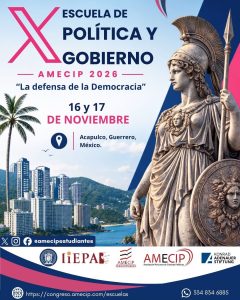
X Escuela de Política y Gobierno AMECIP

Por Karina González / agosto 14, 2026

Teodoro González de León. Diálogos en concreto: 100 años

Por Karina González / agosto 31, 2026

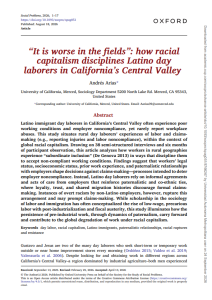
“It is worse in the fields”: how racial capitalism disciplines Latino day laborers in California’s Central Valley

Por Karina González / septiembre 24, 2026

Deja una respuesta Cancelar la respuesta

Tu dirección de correo electrónico no será publicada. Los campos obligatorios están marcados con *

Últimas entradas

Inteligencia artificial: hacia una praxis reflexiva, ética e interdisciplinaria

13 octubre, 2026
Leer más →

La economía de la Menopausia

8 octubre, 2026
Leer más →

Voces que gobiernan: las mujeres indígenas en el poder local

8 octubre, 2026
Leer más →

Inscriben con letras de oro en el Muro de Honor de la Cámara de Diputados la leyenda “475 años de la Universidad de México (1551-2026)”

30 septiembre, 2026
Leer más →

Jornadas Nacionales de Inteligencia Artificial y Ciencias Sociales

24 septiembre, 2026
Leer más →

Premio John D. McCarthy 2027

24 septiembre, 2026
Leer más →

Call for papers – Mobilization: An international quarterly

24 septiembre, 2026
Leer más →

El LAOMS felicita al Dr. Julio Vicente Juárez Gámiz

24 septiembre, 2026
Leer más →

“It is worse in the fields”: how racial capitalism disciplines Latino day laborers in California’s Central Valley

24 septiembre, 2026
Leer más →

Se crea la Cátedra Extraordinaria Cuauhtémoc Cárdenas Solórzano “Democracia y Elecciones”

24 septiembre, 2026
Leer más →

Categorías

  • Acervo fotográfico (4)
  • Comunicados (15)
  • Convocatorias (317)
  • Cursos y seminarios (44)
  • Efemérides (85)
    • Calendarios (12)
  • Eventos (315)
    • Archivo (9)
    • Eventos externos (245)
    • Eventos internos (50)
      • Conferencias LAOMS (7)
      • Cortos de investigación (28)
  • Eventos de protesta (34)
    • Derechos humanos y protestas (26)
  • Infografías (20)
  • Léxico de la Protesta (1)
  • Programas de estudio (1)
  • Publicaciones (269)
    • Colección Charles Tilly (2)
    • De miembros del LAOMS (25)
    • Descargables (163)
    • Publicaciones Café de Altura (7)
    • Recomendadas (251)
  • Recomendaciones fílmicas (69)
  • REDA (7)

Nube de etiquetas

acción colectiva activismo político activistas América Latina cambio climático Chile ciencia política ciencias sociales convocatoria cortos de investigación covid-19 cultura democracia derechos humanos descargables documental economía economía política emociones Estados Unidos de América eventos gobernanza género historia investigacion justicia medio ambiente memoria mexico movimiento estudiantil movimientos estudiantiles movimiento social movimientos sociales pandemia política protestas protesta social Protest Movements representación política represión resistencias Social Movements sociedad civil sociología violencia
Logo LAOMS

Suscríbete a nuestro boletín

Nosotros

  • Inicio
  • Quiénes somos
  • Proyectos

Accesos directos

  • Publicaciones
  • Blogs
  • Léxico de la protesta
  • Eventos

Contacto

Centro de Investigaciones Interdisciplinarias en Ciencias y Humanidades (CEIICH)
UNAM
Torre II de Humanidades, 6to piso
Ciudad Universitaria, 04510, CDMX

laoms.ceiich@gmail.com

© 2026
Laboratorio de Análisis de Organizaciones y Movimientos Sociales

We ♥ Wordpress | Diseño por rholguinc