Logo LAOMS Laboratorio de Análisis de Organizaciones y Movimientos Sociales
  • Inicio
  • ¿Quiénes somos?
    • Directorio
    • Miembros
      • Estudiantes
      • Académicos
    • Ubicación
  • Investigación y Docencia
    • Derechos humanos y protestas
      • Defender es un derecho
    • Características y trayectorias de los eventos de protesta en México
    • Evaluación del desempeño asociativo
      • Presentación
      • Publicaciones
    • Sociedad civil
    • Programas de estudio
    • Publicaciones
    • Infografías
    • Conferencias
    • Cortos de investigación
    • Eventos
      • Archivo de eventos
  • Léxico de la Protesta
  • Red
  • Servicio Social
  • Difusión
    • Publicaciones
      • De miembros del LAOMS
      • Descargables
      • Recomendadas
      • Colección Charles Tilly
    • Calendarios de efemérides
    • Recomendaciones fílmicas
    • Revistas
    • Eventos
    • Convocatorias
    • Cursos y seminarios
    • Comunicados
    • Enlaces
  • Fototeca
  • Sesión
  • Blogs
  • Movimientos e instituciones
  • Observatorio de la Democracia
  • Incidencia Pública
Publicaciones

Contested Legitimacies

Por Laura Gutiérrez / 21 febrero, 2022

Contested Legitimacies
Repression and Revolt in Post-Revolutionary Egypt

Jannis Julien Grimm

Preface
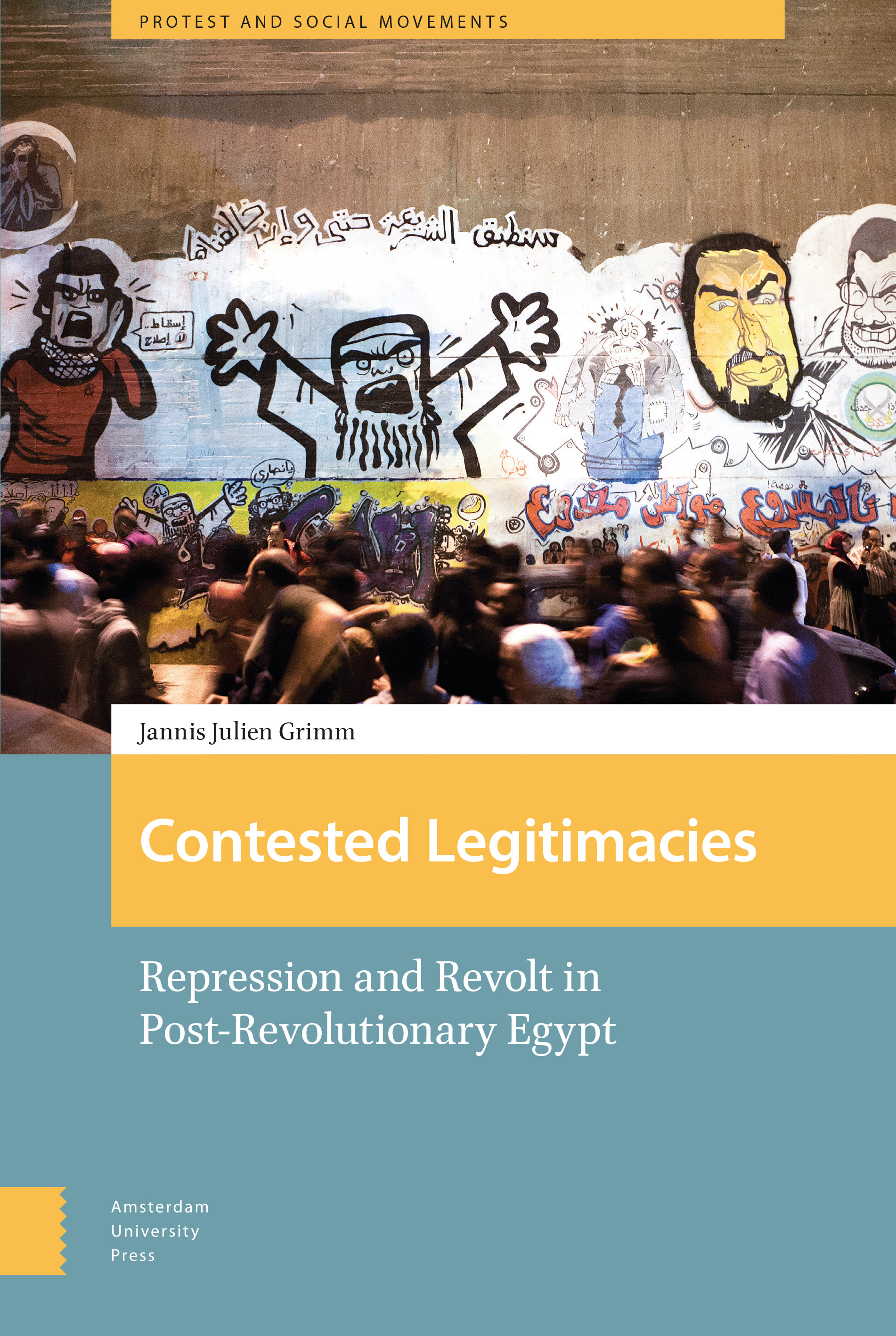
Contested Legitimacies Repression and Revolt in Post-Revolutionary Egypt Jannis Julien Grimm

Contested Legitimacies
Repression and Revolt in Post-Revolutionary Egypt
Jannis Julien Grimm

Accounts of revolutions are necessarily situated and partial. As Jack Shenker (2016) writes, “What defines a revolution – where it can be located on a calendar and a map, what it includes, who speaks for it, the things it seeks to change – is never a neutral question” (p. 11). Accordingly, this book is political by default: for its perspective, which honors the premise that “the vision is better from below” (Haraway, 1988, p. 584); for its choice of topic – an investigation of struggle and contention within a regime that professes unity and concordance; and for its source archive, which gives voice to the mobilized people as the agents of change.

Many of the crises described and investigated in this book are rooted in group-based forms of inequality. These inequalities are not just testing grounds for refining and elaborating theory. On the contrary, they are real arenas of struggle that affect the livelihoods of real people. Critical research must recognize these struggles as such by taking them as the point of departure and by aiming towards their solution. Discourse analytical projects, such as this book, have a particular responsibility in this regard because power relations that cement inequalities and legitimize oppressive modes of domination have a vital discursive basis of reproduction – in Egypt as much as elsewhere. Accordingly, I hope that this book remains not just an academic treatise, evaluated only by methodological quality criteria, but one that also provides some insights for activists on how to maintain their resistance in the darkest hour. The presented cases demonstrate that even when the physical space is limited for protest, there often remains discursive space for contesting oppressive power relations.

Different stories could have been explored in this book about Egypt’s post-revolutionary trajectory. One could think about exploring how the Rabaa massacre has produced embodied memories that still leave an imprint on Egyptians’ fears, desires, and action choices today. One could explore how Egyptians have grappled with individual and collective memories of bloodshed. One could investigate how the nationalist turn has catalyzed the emergence of an affective regime to govern the desires that were born out of the revolutionary experiences of 2011. Or, more modestly, one could explore how emotions in Egypt, up until today, are subjected to a friend-foe binary to support the antagonizing of all those who dare articulate dissent. Given the constraints of this book, I am unable to follow up on these and many other threads. Nor am I able to write about the variety of actors who have been mentioned in this book in passing and whose voices have not been explored with the same level of detail. To reach a better understanding of those fateful months after the military coup in Egypt, it would be necessary to explore these silences in more detail. Aware of these constraints, I don’t claim to provide an exhaustive account of Egypt’s bloody summer of 2013. The presented truths must be taken as “positioned truths” (Abu-Lughod, 2014, p. 468). Many more stories could be told without providing a complete picture. I believe that putting these different perspectives into dialogue with one another is what gives our individual subjective accounts value and worth.


Descargar documento

Descargar introducción

Siguiente ➝
Seminario Economía y Complejidad

Te puede interesar

La economía de la Menopausia

Por Karina González / octubre 8, 2026

III Congreso Internacional de Estado Abierto y Gobernanza

Por Karina González / octubre 16, 2026

Presentación editorial: Clásicos de las Ciencias Sociales y las Humanidades

Por Karina González / agosto 12, 2026

Lecturas indispensables para comprender el cambio climático desde todas las ciencias

Por Karina González / septiembre 24, 2026

Deja una respuesta Cancelar la respuesta

Tu dirección de correo electrónico no será publicada. Los campos obligatorios están marcados con *

Últimas entradas

Programa del III Congreso Internacional de Estado Abierto y Gobernanza

27 octubre, 2026
Leer más →

Concurso Público General de Ingreso a larama Técnico-Administrativa del Servicio Exterior Mexicano 2026

20 octubre, 2026
Leer más →

Ayuda a proteger Santa Elena, su biodiversidad y el agua de la región

19 octubre, 2026
Leer más →

III Congreso Internacional de Estado Abierto y Gobernanza

16 octubre, 2026
Leer más →

Conferencia magistral: Dr. David Edgerton

16 octubre, 2026
Leer más →

Conferencia magistral: Dr. Antoni Roca-Rosell

16 octubre, 2026
Leer más →

Jornadas de Historia de la Tecnología UNAM-ICOHTEC 2026

16 octubre, 2026
Leer más →

Inteligencia artificial: hacia una praxis reflexiva, ética e interdisciplinaria

13 octubre, 2026
Leer más →

La economía de la Menopausia

8 octubre, 2026
Leer más →

Voces que gobiernan: las mujeres indígenas en el poder local

8 octubre, 2026
Leer más →

Categorías

  • Acervo fotográfico (4)
  • Comunicados (16)
  • Convocatorias (318)
  • Cursos y seminarios (44)
  • Efemérides (85)
    • Calendarios (12)
  • Eventos (320)
    • Archivo (9)
    • Eventos externos (250)
    • Eventos internos (50)
      • Conferencias LAOMS (7)
      • Cortos de investigación (28)
  • Eventos de protesta (34)
    • Derechos humanos y protestas (26)
  • Infografías (20)
  • Léxico de la Protesta (1)
  • Programas de estudio (1)
  • Publicaciones (269)
    • Colección Charles Tilly (2)
    • De miembros del LAOMS (25)
    • Descargables (163)
    • Publicaciones Café de Altura (7)
    • Recomendadas (251)
  • Recomendaciones fílmicas (69)
  • REDA (7)

Nube de etiquetas

acción colectiva activismo político activistas América Latina cambio climático Chile ciencia política ciencias sociales convocatoria cortos de investigación covid-19 cultura democracia derechos humanos descargables documental economía emociones Estados Unidos de América eventos gobernanza género historia investigacion justicia medio ambiente memoria mexico movimiento estudiantil movimientos estudiantiles movimiento social movimientos sociales pandemia política protestas protesta social Protest Movements representación política represión resistencias Social Movements sociedad civil sociología tecnología violencia
Logo LAOMS

Suscríbete a nuestro boletín

Nosotros

  • Inicio
  • Quiénes somos
  • Proyectos

Accesos directos

  • Publicaciones
  • Blogs
  • Léxico de la protesta
  • Eventos

Contacto

Centro de Investigaciones Interdisciplinarias en Ciencias y Humanidades (CEIICH)
UNAM
Torre II de Humanidades, 6to piso
Ciudad Universitaria, 04510, CDMX

laoms.ceiich@gmail.com

© 2026
Laboratorio de Análisis de Organizaciones y Movimientos Sociales

We ♥ Wordpress | Diseño por rholguinc